




For the roughly 400 million entrepreneurs around the world, the challenges posed by complex social and economic problems – from poverty to social inequality to climate change – are seen as opportunities to find new solutions or meet an unmet need.
In his speech during July’s Global Entrepreneurship Summit in Kenya, President Obama called entrepreneurs “the spark of prosperity,” becoming a growing force in global development at the forefront of the United States’ engagement agenda. The U.S. Agency for International Development (USAID) sees entrepreneurs as critical to achieving its mission of ending extreme poverty. They represent a key pathway to fighting poverty by advancing economic progress and scaling up marketbased solutions.
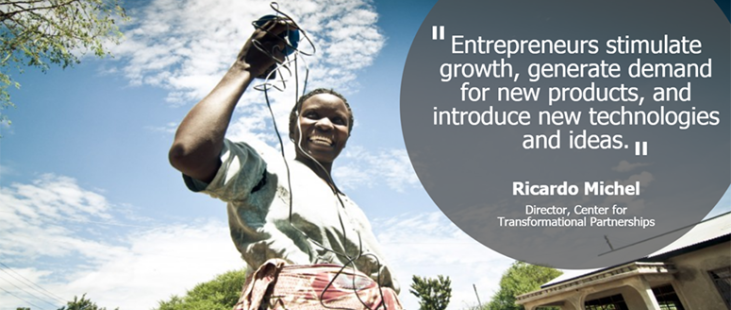
Entrepreneurs stimulate growth, generate demand for new products, and introduce new technologies and ideas. By increasingly providing poor customers access to essential goods and services – such as clean water, reliable energy and accessible financial services – entrepreneurs are generating important social impact, extending solutions to areas that are traditionally underserved.
However, good ideas do not always have the resources and support to grow, so USAID is working to address three key challenges faced by entrepreneurs:
Challenge 1: Access to the right funding at the right time
Securing funding is almost always named as the top challenge among entrepreneurs. But, it’s not just knowing where to get money, it’s also obtaining the right type of funding to best suit the appropriate stage of an enterprise’s growth.
We believe that donor support funding can be catalytic in helping entrepreneurs test their models and attract commercial investment. One way we do this is through USAID’s Development Innovation Ventures (DIV) program, a yearround funding competition that functions like a venture investment vehicle. DIV tests relatively unproven concepts from social enterprises of all sizes and stages of business. This program is tailored to innovators with good ideas to get the support they need.
USAID also uses its Development Credit Authority (DCA) to spur small business growth in developing countries. DCA portfolio guarantees partially back local bank lending to specific sectors of development. This allows earlystage enterprises to access competitive commercial loans from local banks.
Challenge 2: Training and skills to run a business; networks and mentors to succeed
Small and Growing Businesses (SGBs) often lack the talent management and business development services they need to grow. To address this need, USAID partners with investors and accelerators to support entrepreneurial ecosystems.
For example, USAID’s Partnering to Accelerate Entrepreneurship (PACE) initiative works with intermediaries to address the challenges facing SGBs by providing acceleration services and blended capital. Working in partnership with over 20 incubators, accelerators and seedstage impact investors, we have created 10 publicprivate partnerships that leverage $61 million in combined public and private investment to support the growth of earlystage enterprises in developing countries.
Because we know that mentorship is also a key to success, we invest in young entrepreneurs through partnerships like Echoing Green’s Global Fellows Program. Echoing Green Fellows receive funding, technical support and access to a powerful network of mentors that can often be the tipping point in getting ventures off the ground.
Challenge 3: Finding the best help to achieve the right outcomes
According to Emory University, there are anywhere from 1,000 to 2,000 accelerators around the world. Providing technical assistance and investment readiness support, incubators and accelerators are an integral part of the entrepreneurial ecosystem.
However, there has been little research to date on their overall effectiveness. To determine which programs are effective, and under what circumstances, USAID is supporting the Global Accelerator Learning Initiative. The creation of a public database – in collaboration with the Aspen Network of Development Entrepreneurs, Emory University, Omidyar Network, The Lemelson Foundation and the Argidius Foundation – will help entrepreneurs determine what successful incubators exist, and how to find the right fit. In addition, donors, funders and investors can direct their funding to the most proven approaches to get the most value for their money.
The Week Ahead
As entrepreneurs continue to put their mark on global problem solving, we need to deepen the ties between corporations, civil society, governments and entrepreneurs around the world to cultivate a thriving ecosystem.
Follow this blog throughout the week to hear from several of our partners, who will be addressing key aspects and challenges of the entrepreneurship ecosystem and the programs and partnerships that have developed to help solve important global challenges.
View additional posts in the USAID blog series.
Photo credit: Angaza Design
Ricardo Michel is the director of the Center for Transformational Partnerships in the U.S. Global Development Lab at USAID, responsible for the overall strategic direction to best use local and global public-private partnerships for accelerated sustainable development. Previously, Ricardo served as acting director for the Office of Innovation and Development Alliances, where he oversaw the agency’s efforts to find innovative solutions, including mobile technology and public-private partnerships, to address development challenges. Ricardo also served as the senior adviser for economic growth and trade in the Agency’s Bureau for Africa.